Ready for the follow-up question.
For students aged 10–16 preparing for interviews at UK boarding schools and international schools, in China and around the world. Live online, in English, with Teacher Memi. Your child learns to think on their feet, not to recite.
What interviewers are listening for
An admission interview isn’t a memory test. Interviewers ask follow-up questions to see how a child thinks, and memorised answers fall apart at the first one.
- An answer of their ownAn opinion they actually hold, in their own words.
- ReasonsWhy they think it, explained clearly, one step at a time.
- The follow-upStaying calm when the interviewer pushes back, and thinking again out loud.
- Speaking upKeeping the conversation going in English, not just the first answer.
The question after the question
Questions like these come up in many school interviews. Try them at home: ask one, listen, then ask the follow-up. The follow-up is where children get stuck, and it’s what debate trains.
Tell me about yourself.
Then askWhat’s something you’ve changed your mind about?
Why do you want to come to this school?
Then askWhat would you miss about your old school?
What’s a book you enjoyed?
Then askWould you recommend it to someone who doesn’t like reading? Why?
Should students wear school uniforms?
Then askWhat’s the best argument for the other side?
Is social media good for young people?
Then askHow could we check that?
If you could change one thing about your school, what would it be?
Then askWhy that, and not something else?
Don’t correct their English while they answer. Listen for reasons. If the answer is “because it’s good”, ask “why?” once more.
How the classes prepare them
Students don’t rehearse answers. Every class, they practise what an interview tests.
- DebateEvery argument gets challenged, so students learn to stay calm, think on their feet and explain their reasoning.
- Both sidesStudents often argue the side they disagree with, so a question from an unexpected angle doesn’t throw them.
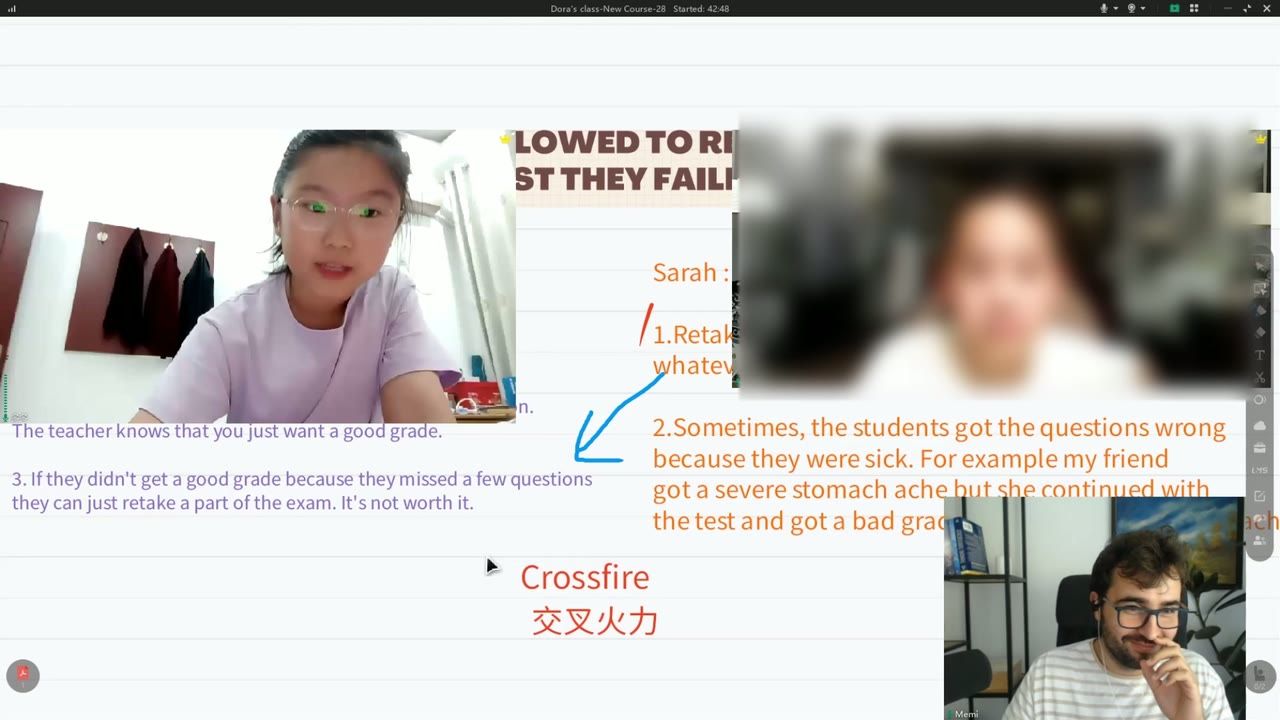
- CrossfireDebaters question each other directly and answer on the spot, much like an interviewer’s follow-up.
- Practice interviewsInterview questions come up in the debates too. In 1-on-1 classes, your child can also do full practice interviews: just ask.
- BookletsEvery two classes are built around one of Teacher Memi’s booklets, on topics chosen for their age, such as fame or school uniforms.
Answering on the spot
In crossfire, debaters question each other and have to answer straight away. Here a student takes on her teacher.
What parents and students say
“Since starting with [Teacher Memi], my daughter actually enjoys arguing her point in English. Her last school interview went better than any we’d prepared for before.”
“We tried several English tutors before this. The difference is that my son now has opinions — and knows how to express them clearly. His teachers have noticed.”
Two ways to prepare
Private Mentorship
Group size: 1-on-1
For focused interview preparation, at times that suit you.
- Full practice interviews, if you ask for them.
- Any time between 06:00 and 17:00 UK time.
- A short report every week.
$120 per class$1,200 per term
Logic Lab
Group size: 2–4 students
For debate practice with other students: different opponents, different questions.
- Students are matched by age, English level and time zone.
- A short written update every four classes.
$50 per student, per class$500 per term
In the trial form, tell me which school or interview your child is preparing for, and I’ll suggest what fits.
After the interview
The interview is why many families come to me. Thinking and speaking well in class is why they stay. Once a student is accepted, their new classes ask for the same things: an opinion, reasons, and the confidence to speak up. Later on, university interviews ask for them again.
“Thinking is the foundation of a life. If the foundation is wrong, nothing you build on top of it will be stable.”
Teacher Memi
Questions first? Write to memi@unshakablemind.com. I reply within 24 hours.